
/npm214%20Digital_H_UB151.1.jpg)
/Author%20Profile%20Ainsworth_Anthony_G.png?width=100&name=Author%20Profile%20Ainsworth_Anthony_G.png)
Interruptions to UK winter energy supplies: how to prepare
How can businesses access electricity cost exemptions?
Is a fairer route to Clean Power 2030 needed for UK businesses?
British Industrial Competitiveness Scheme (BICS) Guide
Rise of energy and AI: balancing competitiveness with sustainability
The 2026 Business Energy Tracker shows how rising business energy invoices, reflecting higher non-commodity costs, are putting UK competitiveness and confidence in Clean Power 2030 under pressure. That’s why businesses are urging the government to spread the cost of the transition more fairly as they prepare for a looming cost peak in winter 2027/28.
Each year, our Business Energy Tracker surveys hundreds of major energy users to get a clear view of how energy is shaping decisions inside UK businesses. We are now on our fifth edition, and one finding has remained consistent: energy prices are the biggest risk facing businesses.
What has changed is the source of that pressure. Previously, energy crises have been driven by wholesale market volatility. Today, non-commodity charges – the network, system and policy costs – are increasingly driving up the cost of energy invoices. So while businesses have found ways to weather wholesale market volatility, they now face a sustained rise in costs they cannot control.
Five key takeaways from this year’s report
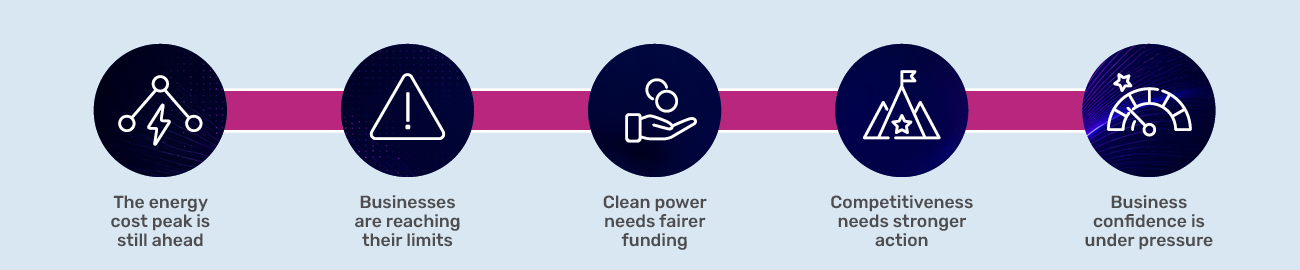
1. The cost peak is still ahead
The most urgent finding is that the greatest cost pressure may still lie ahead. Our modelling suggests winter 2027/28 will bring the highest peak-period costs between now and 2031, reaching around £523 per megawatt hour (MWh) in January 2028, driven by the Capacity Market (CM) and other non-commodity charges. That leaves businesses just over a year to understand their exposure and decide how to respond.Businesses are operating from a difficult position. Our analysis shows that large UK businesses pay 130% more for electricity than the median across 14 European Union (EU) countries, including France, Germany and Italy. That gap is concerning because the impending peak will place further pressure on businesses already at a substantial cost disadvantage, making it harder for them to invest and compete.
2. Businesses are being proactive, but are reaching their limits
We are seeing signs that businesses are adapting to persistent volatility. The proportion of respondents saying energy costs are harming corporate confidence has fallen from 54% last year to 41% in 2026. Energy efficiency remains the most common measure to manage energy risk, while more organisations are investing in on-site generation and flexibility. These are positive steps.
The British Industrial Competitiveness Scheme (BICS), which exempts around 10,000 manufacturing-related businesses from some non-commodity costs, is a welcome government response, though its eligibility is limited.
As a result, 86% of respondents want targeted financial support for those outside its scope. BICS can support important parts of manufacturing, but it cannot resolve the wider competitiveness challenge alone.
3. Clean Power 2030 depends on a fairer deal
Our findings show that businesses understand the benefits of a renewable energy system. They also accept that the commercial sector will need to contribute to the transition. But their continued support will depend on whether the route to Clean Power 2030 remains affordable.
Against a backdrop of low confidence, one in 10 businesses now say they would like the Clean Power 2030 target delayed until 2035. This is a warning that the way we are funding the transition is eroding confidence in the timetable, even though businesses do not want the target scrapped.
Asking them to absorb costs outside their control at this pace is like trying to pay off a mortgage in five years rather than over 30. The ambition remains right, but we must spread the costs more fairly and over a longer period to protect UK competitiveness.
4. UK businesses want more government support
The message to government is straightforward. The way the UK’s clean power ambitions are funded risks creating a competitiveness crisis unless the costs are spread more fairly and over a longer period. The challenge is clear: UK businesses need support if they are to have the confidence to invest and manage the long-term cost of the transition.
Businesses have told us the policy measures that would help. Direct financial support is the leading ask of government. Over the longer term, they want a stronger Corporate Power Purchase Agreement (CPPA) market and better opportunities to earn revenue from energy flexibility, giving them more control over future costs. Finance packages for on-site energy generation and reduced planning ‘red tape’ for renewable schemes are also priorities.
5. Businesses say net zero needs to prove its worth
When it comes to net zero, it appears we have firmly entered an era of pragmatism. While almost half (49%) remain committed to net zero, one in 10 are reconsidering or scaling back their commitments, and 84% agree that measures to reach net zero need clear financial benefits to secure senior-level buy-in. So, while businesses remain broadly committed to the concept of net zero, the measures needed to achieve it must make commercial sense.
Business confidence needs an affordable transition
The findings lead to a clear conclusion. The transition to Clean Power 2030 must remain affordable to sustain business confidence. With the cost peak approaching in winter 2027/28, the government has a narrow window to act, and businesses have limited time to prepare.
At nBS, we will continue to bring the voice of businesses to government, making the case for a fairer approach that protects UK competitiveness while helping our customers understand their exposure and how to manage their risk.
Download the 2026 Business Energy Tracker
Download the 2026 Business Energy Tracker to understand what lies ahead and how your organisation can prepare.
Related Content

100 Days of Labour - is it good news for business energy users so far?
/npm214%20Digital_H_UB146.jpg)
Energy flexibility: fact versus fiction
UK energy markets: 8 things businesses need to know this summer

2025 to 2026: key milestones, business challenges and future outlook
Unlock your energy potential with npower Business Solutions
/npm214%20Digital_H_UB121.jpg)
How to unlock the power of your business energy data
/npm214%20Digital_H_UB149.jpg)
The rise of energy and AI: balancing competitive advantage with sustainability impact
/npm214%20Digital_H_UB94.jpg)